


Man’s Three-Year Ordeal: A Husband’s Cry for Help Amidst Domestic Abuse Claims in Mutare
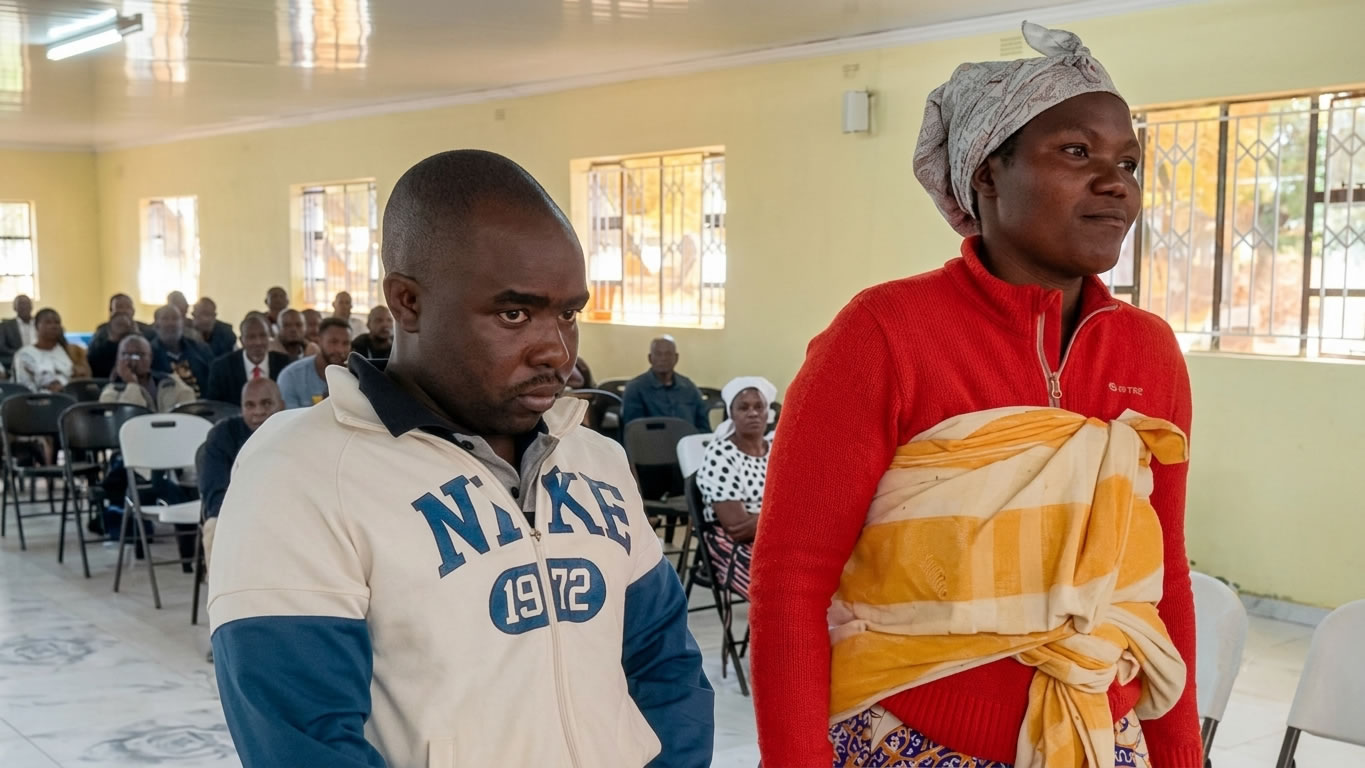
Mutare – In a deeply unsettling case that has emerged from Chief Mutasa’s court, a Mutare man, Lloyd Samanyanga, has bravely come forward to detail a harrowing three-year ordeal of alleged domestic abuse at the hands of his wife, Dorcas Dzvairo. His account paints a grim picture of a marriage plagued by violence, leaving him physically scarred and living in constant fear. The revelations have cast a spotlight on the often-overlooked issue of male victims of domestic violence in Zimbabwe, prompting calls for greater awareness and support.
Samanyanga’s plight became public during a recent hearing at Chief Mutasa’s court, where he sought judicial intervention to end the alleged abuse. His visibly swollen face as he spoke was a stark testament to the severity of his claims, immediately drawing the attention and concern of those present. He recounted how the violence began shortly after his marriage to Dzvairo in 2023, and has persisted despite repeated attempts by both their families to mediate and reconcile the couple.
“My wife abuses me terribly. Since I married her, I have never known peace,” Samanyanga stated, his voice heavy with emotion. “I sought help from my parents, and they tried to talk to her, but nothing changed. I also reported the matter to her parents, who tried to reconcile us many times, but the beatings have not stopped.” His words highlight the profound sense of helplessness experienced by victims who find themselves trapped in cycles of violence, even when family members are aware of the situation.
Initially, Samanyanga believed the marital discord stemmed from their inability to conceive. “At first, I thought she was troubled because we didn’t have children,” he explained. The couple’s subsequent blessing with a child, however, did not bring the hoped-for peace. “Nothing changed. I continued to be beaten as if I were a thief in my own home,” he lamented, indicating that the root of the problem lay deeper than initial assumptions.
As the situation escalated, the desperation for a solution led the couple down an unconventional path. Samanyanga revealed that his wife’s parents suggested they consult prophets, a common practice in some Zimbabwean communities when faced with intractable problems. At the prophet’s place, they received a startling diagnosis: the marital strife was attributed to an evil spirit, a ‘chikwambo’ – a type of goblin or malevolent entity in Zimbabwean folklore – believed to be afflicting Dzvairo. The prophet reportedly advised that a traditional ritual, which should have been performed before their marriage, was necessary to appease the spirit. “We followed this advice, after which she became pregnant, and we were blessed with a child,” Samanyanga recounted, suggesting a temporary reprieve or a perceived resolution to one aspect of their struggles.
Despite these efforts, the violence continued. Samanyanga attributes the ongoing conflict, in part, to external influences and financial strain. “She believes everything people tell her. She listens to gossip and attacks me without giving me a chance to explain myself,” he claimed. He further elaborated on accusations from his wife regarding his salary. “She accuses me of giving all my salary to my mother and not taking care of my family, but the truth is that the money I earn is not enough.” This financial pressure, coupled with external gossip, appears to fuel the domestic tensions.
Recounting a particularly brutal incident, Samanyanga described a recent attack while he was unwell. “Last week, I wasn’t feeling well, and I was playing with our child when she attacked me. She used a cooking stick to beat me and bit me in different places. My face is still swollen from that beating. I am constantly being beaten,” he stated, his testimony painting a vivid picture of the physical toll of the abuse. The use of a cooking stick, a common household item, underscores the insidious nature of domestic violence, where everyday objects can become weapons.
In a desperate attempt to escape the cycle, Samanyanga had previously reported the abuse to Penhalonga Police Station. However, he later withdrew the case, driven by a desire to preserve his marriage. “I withdrew the case from the police because I love my wife and wanted to save my marriage. Looking back now, I see that nothing changed after I withdrew the case from the police,” he reflected, highlighting the difficult choices victims often face between seeking legal protection and attempting to salvage a relationship.
Samanyanga also pointed to his wife’s alleged excessive alcohol consumption as a contributing factor to her violent behaviour. “She drinks alcohol, and I believe that’s what causes her to behave this way. She values her friends more than me. Whenever I suggest we visit her parents in Buhera for reconciliation, she refuses because she doesn’t want to leave her friends,” he asserted, suggesting a pattern of behaviour exacerbated by substance use and a reluctance to engage in family-led interventions.
Dorcas Dzvairo’s Counter-Claims and the Broader Context of Domestic Disputes
Dorcas Dzvairo, however, vehemently denied her husband’s accusations, presenting a counter-narrative to the court. “He is lying. He and his family want me to be seen as a bad person. What they are saying about me is not true. I don’t drink alcohol,” she retorted, dismissing the claims of abuse and alcohol consumption as a conspiracy to tarnish her reputation. Her denial underscores the complex and often contradictory nature of domestic disputes, where narratives diverge sharply.
Dzvairo, in turn, accused Samanyanga of failing to adequately provide for their family, asserting that financial difficulties were at the heart of their disagreements. “He doesn’t bring money home to support the family. Whenever I ask him about money, he says that building a house for us to live in is the same as having food, and there’s nothing else I should ask for. My children don’t know what their father’s money looks like, but he is well-known in local shops for buying snacks and eating them alone,” she claimed. This accusation of financial neglect and hypocrisy adds another layer of complexity to the couple’s troubled relationship, suggesting that economic stress is a significant factor.
Further revealing the depth of their marital breakdown, Dzvairo disclosed that their intimate relationship had also deteriorated. “It’s been two months now since we had sex,” she stated. This revelation prompted Chief Mutasa to intervene, posing a poignant question that encapsulated the dire state of their union: “Would anyone enjoy sex if a cooking stick is constantly hanging over their head?” The Chief’s observation powerfully illustrates the psychological impact of constant fear and abuse on intimacy and marital harmony.
Witness Corroboration and Chief Mutasa’s Counsel
Adding weight to Samanyanga’s claims, his niece, Patience Kaisa, corroborated his statements before the court. Kaisa testified that she had intervened multiple times during the couple’s altercations. “I have stopped their fights many times. This woman also beat Samanyanga’s mother and prevented her from seeing her grandchild. I once advised them to go to the police and the women’s affairs department for help,” she revealed, painting a picture of a household where violence was a recurring event and even extended to other family members.
Kaisa further highlighted the physical evidence of the abuse. “If you see the scars on his body, you will feel sorry for him. He is currently staying at my house because he is afraid to go back home,” she told the court. Disturbingly, Kaisa also recounted an incident where Dzvairo’s father, instead of facilitating reconciliation, allegedly advised Samanyanga to retaliate when his wife beat him. This counsel, if true, speaks to a deeply problematic and dangerous approach to resolving domestic conflict within some family structures.
After hearing both sides of the distressing case, Chief Mutasa delivered a stern condemnation of all forms of violence. “Marriage is not a boxing ring. Violence has no place in the home whatsoever. The two families must put their heads together to resolve this problem,” he declared, emphasising the sanctity of marriage and the need for peaceful resolution. He strongly encouraged Samanyanga to report all future instances of abuse to the police, stressing that legal channels must be pursued. “If there is any violence, it should be reported to the police. The law must be allowed to take its course, while families work to resolve the issues,” Chief Mutasa advised, advocating for a dual approach of legal enforcement and family mediation.
The Silent Epidemic: Male Victims of Domestic Abuse in Zimbabwe
Samanyanga’s case, while deeply personal, is not an isolated incident. It brings to the fore the often-underreported issue of domestic violence against men in Zimbabwe and globally. While societal narratives frequently focus on female victims, men too suffer abuse, often in silence due to stigma and cultural expectations. Statistics from organisations like Mankind Initiative in the UK indicate that one in fifteen men (6.5%) reported being a victim of domestic abuse in 2024/25, amounting to 1.5 million men. While these are UK figures, they highlight a global phenomenon that resonates in contexts like Zimbabwe.
In Zimbabwe, cultural idioms such as “indoda ayikhali” (“a man does not cry”) reinforce the notion that men must endure suffering silently. This cultural conditioning, coupled with societal perceptions of masculinity, often prevents male victims from reporting abuse or seeking help. The fear of ridicule, disbelief, and the perception of weakness can be overwhelming, leading to a culture of silence, shame, and isolation.
Recent news from Zimbabwe, though sometimes anecdotal or from social media, occasionally surfaces cases that mirror Samanyanga’s experience. For instance, in March 2024, a Bulawayo woman, Ellen Ndhlovu (38), pleaded guilty to assaulting her police officer husband, Ndoro, after he allegedly took too long to open the door. Ndhlovu was subsequently granted US$30 bail, highlighting that legal action against female perpetrators does occur, albeit perhaps less frequently reported than cases involving male perpetrators. Such incidents, though seemingly minor in comparison to Samanyanga’s prolonged ordeal, underscore the reality that domestic violence is not gender-exclusive.
Another case, though older, from Bulawayo24 in 2015, reported that over 2,000 male victims had come forward to report domestic violence in that year alone. This figure, even from a decade ago, suggests a significant, though often unacknowledged, prevalence of male victimisation. The challenge lies in encouraging more men to break the silence and for society to recognise and address their suffering without prejudice.
Moving Forward: Breaking the Cycle of Violence
Lloyd Samanyanga’s brave testimony before Chief Mutasa’s court serves as a poignant reminder that domestic violence knows no gender. It is a complex issue, often intertwined with financial stress, external influences, and deeply ingrained cultural beliefs. The case highlights the urgent need for comprehensive support systems that cater to all victims of domestic abuse, irrespective of their gender.
For men like Samanyanga, seeking help is an arduous journey, fraught with societal judgment and personal struggle. Chief Mutasa’s advice to report all instances of violence to the police, while simultaneously encouraging family mediation, offers a balanced approach to tackling such sensitive issues. It is imperative that communities, legal systems, and support organisations work collaboratively to dismantle the stigma surrounding male victimisation, ensuring that every individual living in fear, whether male or female, has a safe avenue to seek justice and peace.