


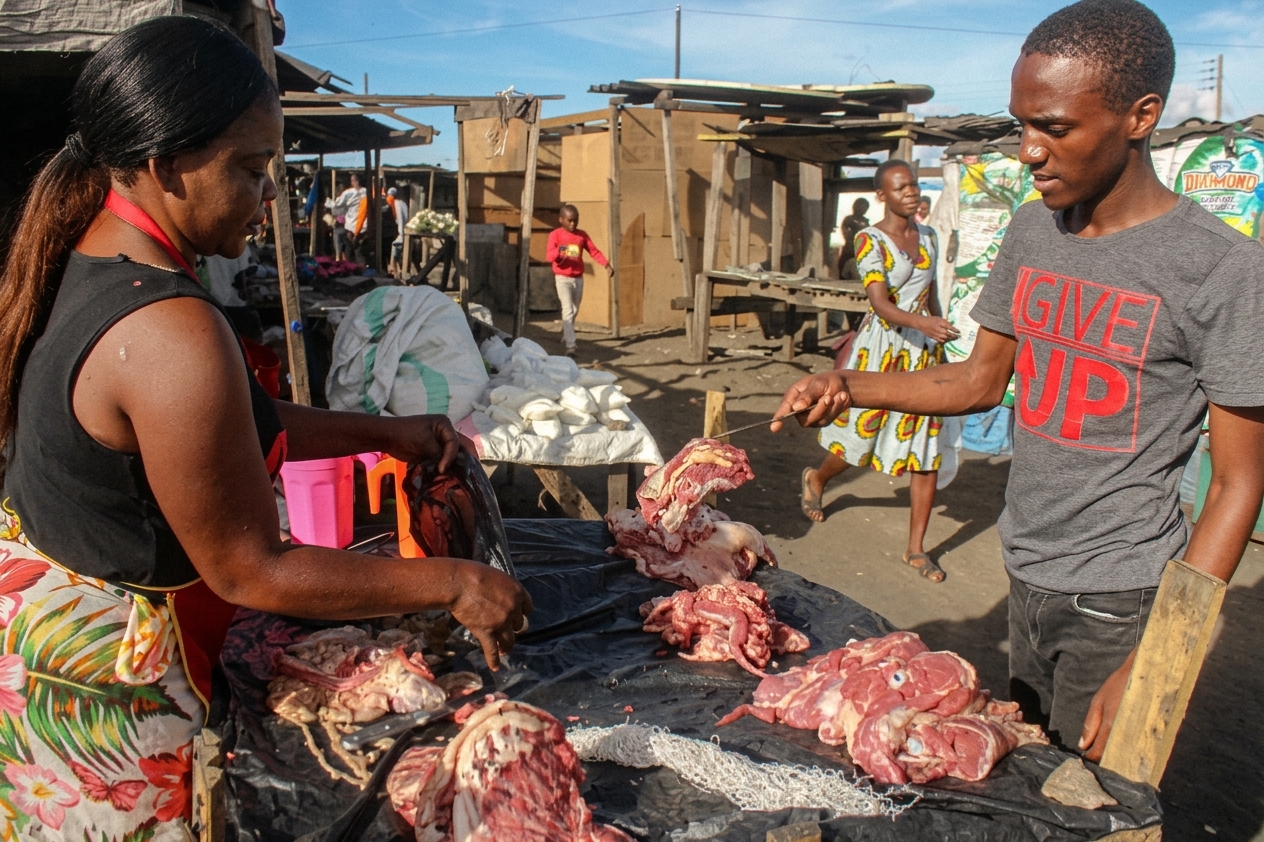
MUTARE — Beef selling for as little as US$2 per kilogramme in parts of Mutare has prompted a strong police warning, with authorities investigating whether meat from unapproved slaughter points is entering the city’s informal markets without veterinary inspection or transport clearance.
The unusually low prices have been reported in Sakubva, Dangamvura and Chikanga, where several butcheries, including some operating from backyard premises, are offering beef well below prevailing market rates. Some traders are reportedly packing meat into paper bags and selling each package for a flat US$10 instead of weighing it on standard scales.
The practice has raised concern about how the meat is sourced, handled and moved before it reaches consumers. Police say the issue is not simply that shoppers are being offered a cheaper product. It also involves the ownership of livestock, the legality of slaughter points, veterinary inspection, transport documentation and the safety of meat being sold to the public.
Acting Manicaland provincial police spokesperson Assistant Inspector Wiseman Chinyoka confirmed that police had received reports about the suspiciously cheap beef in Mutare and were investigating the supply chains behind it.
“Police in Manicaland have received reports about cheap beef on the market in some areas in Mutare, particularly where such meat may be originating from unapproved slaughtering points or being transported without the requisite documentation and clearance,” he said.
The warning comes as police and veterinary officials face a series of cases involving the movement of cattle and carcasses outside approved channels. In Nyamaropa, officers recently intercepted 14 cattle being transported without clearance. In Zimunya, seven uninspected carcasses were recovered, while further carcasses were found in the Marange area.
Those cases have added urgency to the investigation into the cheap-beef trade. Authorities are examining whether informal sellers are being supplied by illegal slaughter operations, stock-theft networks or traders who are avoiding the inspection and transport procedures required for meat sales.
Assistant Inspector Chinyoka said consumers should look beyond the price when choosing where to buy beef.
“The public should understand that the issue is not simply about the price of beef.
“It is about the source, ownership, inspection, transportation and safety of the meat being offered for sale. Meat which has not gone through the prescribed inspection and public health processes may expose consumers to serious health risks,” he said.
Under the normal meat-supply process, livestock is expected to move with the required documentation and be slaughtered at approved facilities. Veterinary checks are used to identify animals that are unhealthy before slaughter and meat that is not fit for human consumption afterwards. Meat sold through licensed butcheries is also subject to inspections designed to protect consumers from contaminated or improperly handled products.
A public-health notice issued by Masvingo City has similarly warned residents against buying or selling uninspected meat and advised consumers to use registered, licensed butcheries. The notice highlighted the risks of food poisoning and infection and said non-compliant butcheries could be closed. The warning reflects the wider concern facing authorities: once meat has been slaughtered and distributed outside the inspection system, tracing its origin and checking its condition becomes more difficult.
In Mutare, the reported flat-price sales are adding another layer of concern. Selling meat in paper bags for a fixed amount can make it difficult for customers to know how much they are actually buying, while the absence of normal labelling and documented weighing leaves little information about the product’s source. It can also allow traders to move meat quickly through informal networks without the checks applied at established outlets.
Police say they are working with the Department of Veterinary Services, local authorities and other Government agencies to disrupt illegal slaughtering, unlawful livestock movements and the sale of meat products from questionable sources.
“The police in Manicaland Province are working in collaboration with relevant stakeholders, including the Department of Veterinary Services, local authorities and other responsible Government agencies, to intensify measures aimed at detecting and dealing with the illegal movement, slaughter and sale of livestock and meat products,” said Assistant Inspector Chinyoka.
The investigation in Manicaland follows a separate stock-theft case in Mashonaland East in which officers recovered 400kg of deboned beef from a Toyota Probox. Police arrested 34-year-old Filton Kachavi in Featherstone on 13 September after he allegedly failed to stop at a roadblock near Wadyiwa Wamira Shops along the Harare-Masvingo Road.
A chase followed as the vehicle turned on to Charter Road. The pursuit ended when the Probox struck a calf, killing it on the spot. The collision forced the vehicle to stop, allowing officers to arrest the driver and search the car. Eight 50kg bags containing deboned beef were recovered.
National police spokesperson Commissioner Paul Nyathi confirmed the incident.
“On September 13, 2026, Police in Featherstone arrested Filton Kachavi (34) for stock theft following a speed chase,” he said.
“The suspect was driving a Toyota Probox which failed to stop after being signalled by the police near Wadyiwa Wamira Shops, Feartherstone, along Harare-Masvingo Road. “During the ensuing speed chase, the vehicle turned onto Charter Road before striking a calf, which died on the spot.
“The collision brought the vehicle to an abrupt halt, leading to the arrest of the suspect.
“Subsequently, eight 50kg bags containing deboned beef were recovered. Investigations by the police established that the meat had been stolen from two complainants in Mvuma.”
The Featherstone recovery shows how quickly stolen livestock can be turned into deboned meat and moved in a vehicle that gives little indication of what it is carrying. It also underlines the challenge facing officers trying to follow beef from the farm or communal grazing area to the slaughter point, transporter, butcher and final buyer.
Assistant Inspector Chinyoka said police would continue with roadblock checks, inspections and intelligence-led operations targeting the unlawful movement of livestock and carcasses. He warned butcheries, meat traders and transporters not to accept products whose origin cannot be verified.
“They should not become conduits for stolen livestock or uninspected meat,” he said.
Residents have been urged to be cautious when offered beef at prices that appear unusually low and to check whether sellers operate through legitimate and inspected channels. Police are also asking the public to report suspicious slaughtering, the movement of carcasses, suspected stock theft and suppliers dealing in meat from questionable sources.
“We further appeal to members of the public to provide police with information concerning suspicious slaughtering activities, the movement of carcasses, suspected stock theft and persons supplying meat from questionable sources, to any nearest police station or ZRP Manicaland Province Whatsapp number +26371 8188672,” said Assistant Inspector Chinyoka.
Police said operations would continue across Manicaland and that people found involved in stock theft, illegal slaughtering or the unlawful possession and sale of meat products would be arrested and prosecuted. The immediate focus, however, is on tracing the supply of the US$2-per-kilogramme beef and determining how much of it has entered the informal market in Mutare.
For consumers, the warning means that a bargain at the butcher’s counter may come with unanswered questions about where the meat came from, how it was transported and whether it passed through the required inspection process. Authorities are now calling for information from residents as they work to identify the traders and suppliers behind the cheap-meat network.
Efforts to obtain comment from Mutare City Council spokesperson Charles Sadondo were unsuccessful by the time of publication.