


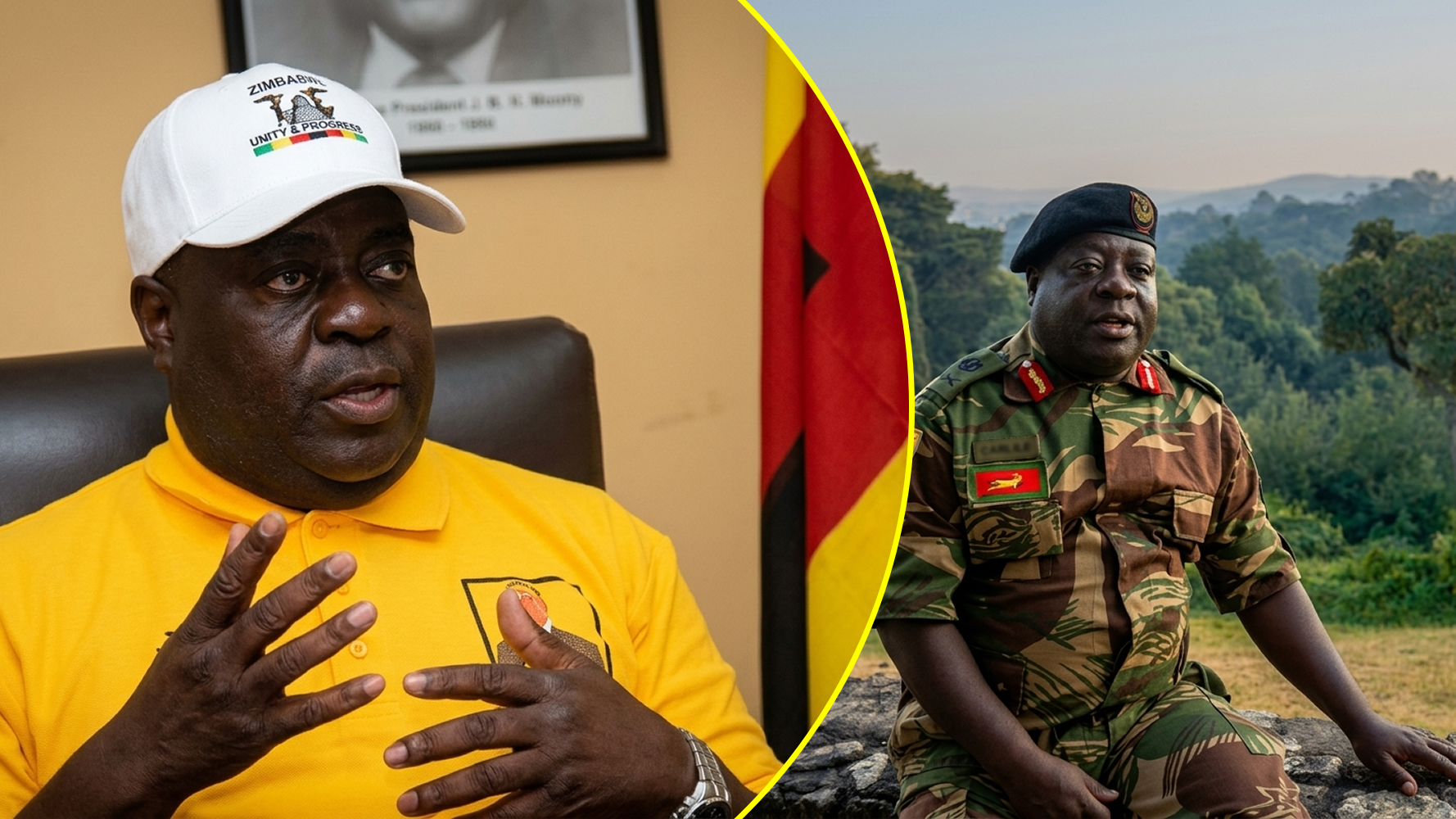
Retired Lieutenant-General Engelbert Rugeje has become the focus of a fresh political dispute in Zimbabwe after reports that he was being considered for the diplomatic post left vacant by the death of Ambassador Victor Matemadanda.
The proposed assignment would place Rugeje in charge of Zimbabwe’s missions in Mozambique and Eswatini, formerly known as Swaziland. But within days, accounts of his position shifted. He was first reported to have rejected the posting, with people close to him citing security, political and financial concerns. A later account said he had agreed to take the job if President Emmerson Mnangagwa formally appointed him. Rugeje then denied rejecting any appointment and said no specific mission had yet been allocated.
The result is an unusual public dispute around a posting that has not been formally announced, but which has exposed the continuing sensitivity surrounding retired military commanders, Zanu PF power structures and the relationship between Mnangagwa and Vice-President Constantino Chiwenga.
Rugeje is a member of the Zanu PF Politburo and is widely regarded as a figure close to Chiwenga. His name became linked to the Maputo mission after Matemadanda suddenly died in June at the age of 66. Matemadanda had served as Zimbabwe’s ambassador to Mozambique and Eswatini since 2021, having moved to diplomacy after holding senior positions in the ruling party and government.
A source familiar with the discussions said Mnangagwa was preparing to send Rugeje to Mozambique. The reported plan gained attention because of the history of the post and because Rugeje has remained a politically active figure after leaving the army and the party’s commissariat.
The first accounts said he did not want to accept the assignment. His reported concerns included the deaths of two senior Zimbabwean figures who had held the Maputo post, the loss of influence that would come with leaving Harare and the cost of abandoning private consultancy work.
People familiar with his circumstances said Rugeje currently earns a reasonable income through consultancy and enjoys a comfortable lifestyle in Zimbabwe. The ambassadorial post was said to offer fewer financial advantages than his current work. One source quoted him as saying: “there is no money there.” Another account put his view more bluntly: “a route to poverty”.
The Maputo assignment also carries a painful recent history. Retired Lieutenant-General Douglas Nyikayaramba was appointed Zimbabwe’s ambassador to Mozambique in 2019 after leaving active military service. He died in Harare on 9 February 2021 after reportedly contracting Covid-19. He was 64 and had been receiving treatment at St Anne’s Hospital.
Matemadanda’s own path to the embassy followed a rapid rise and an equally significant change in political status. He was a liberation war veteran and former secretary-general of the Zimbabwe National Liberation War Veterans Association. He became one of the most vocal critics of former president Robert Mugabe before the 2017 political transition.
After Mugabe was removed in November 2017, Matemadanda became a prominent supporter of Mnangagwa and took over as Zanu PF national political commissar in June 2019. He also became a Member of Parliament for Gokwe Central and was appointed deputy minister of defence and war veterans affairs.
That appointment followed the removal of Rugeje from the same party position. Rugeje had been appointed national political commissar in December 2017, after the military-assisted transition that brought Mnangagwa to State House. In June 2019, the party announced that Matemadanda would replace him and that Rugeje would remain a Politburo member pending redeployment.
“The Politburo has appointed Cde Matemadanda to the position of Secretary for Commissariat replacing Cde Rugeje. Cde Rugeje will remain a Politburo member pending re-deployment in September this year,” the party’s information secretary, the late Simon Khaya Moyo, said at the time.
The promised redeployment did not produce a return to a senior operational command. Rugeje was reportedly considered for the vice-chancellorship of the Zimbabwe National Defence University, but the appointment did not materialise. When Lieutenant-General Edzai Chimonyo died in July 2021, Rugeje was not selected to lead the Zimbabwe National Army.
Instead, retired Lieutenant-General David Sigauke took command of the army. Sigauke served until his retirement in 2023, when Lieutenant-General Anselem Sanyatwe was appointed to replace him. Sanyatwe had been serving as Zimbabwe’s ambassador to Tanzania before being recalled to military command.
The changes placed senior officers associated with the 2017 transition in different positions, taking some out of the military, others out of the party’s central machinery and several into diplomatic or civilian roles. Rugeje’s supporters viewed the movement of these figures as a sustained effort to reduce their influence in Harare.
That history gives the proposed Maputo assignment a political meaning beyond a normal diplomatic appointment. Sending Rugeje to a neighbouring country would take him away from the party’s daily structures and from the network he built during his military and political career. It would also leave him dependent on an official role controlled by the presidency.
Security concerns were also reported. People close to Rugeje linked him to previous shooting and suspected poisoning incidents connected to succession tensions inside the ruling establishment. The same concerns were said to have shaped his reaction to the deaths of Nyikayaramba and Matemadanda, even though Nyikayaramba’s death was attributed to Covid-19 and no cause was given for Matemadanda’s death in the official announcement.
The reported refusal was followed by a second account saying that Rugeje had changed his position. A Zanu PF Politburo member said he would comply if Mnangagwa formally appointed him.
“When this issue came to light, Rugeje didn’t want to take any diplomatic posting for the reasons in your story yesterday, but things have now changed — he says he will comply and take the position if officially appointed,” the Politburo member said.
That account was later followed by a direct denial attributed to Rugeje. He said he had not appointed any social media activist or faceless source as his spokesperson and had never issued a statement rejecting the offer.
“For the record, General Rugeje has not said NO to any appointment. He has not rejected anything because nothing has been rejected,” the statement said.
Rugeje also said the President had not yet allocated missions to designated ambassadors. According to the statement, all designated ambassadors would undergo diplomatic training in the last week of October, after which missions would be assigned.
The denial leaves the central question unresolved: whether Rugeje has been formally offered the Maputo post, whether he has accepted it in principle or whether the discussion remains part of internal planning. What is clear is that the proposed appointment has opened a window into the calculations facing a retired general who still holds a place in the ruling party’s political centre.
For Rugeje, staying in Harare preserves his access to political networks, private work and a familiar security environment. Accepting the posting would give him an official role, but would also take him away from the centre of domestic politics and place him in a mission that has recently lost two ambassadors who were senior figures in Zimbabwe’s military and political establishment.
For Mnangagwa, the appointment would offer a way to place a powerful retired commander in a formal role outside the country’s immediate political arena. But the changing accounts around Rugeje show that such a move cannot be treated as a simple transfer. The decision involves money, personal security, political influence and the question of how much authority the presidency has over figures who once helped shape the balance of power in Zimbabwe.
Until an official appointment is made, Rugeje remains a Politburo member without a publicly confirmed new assignment. The Maputo post remains vacant, and the dispute over whether he refused it, accepted it or has yet to receive it has become a story in its own right.